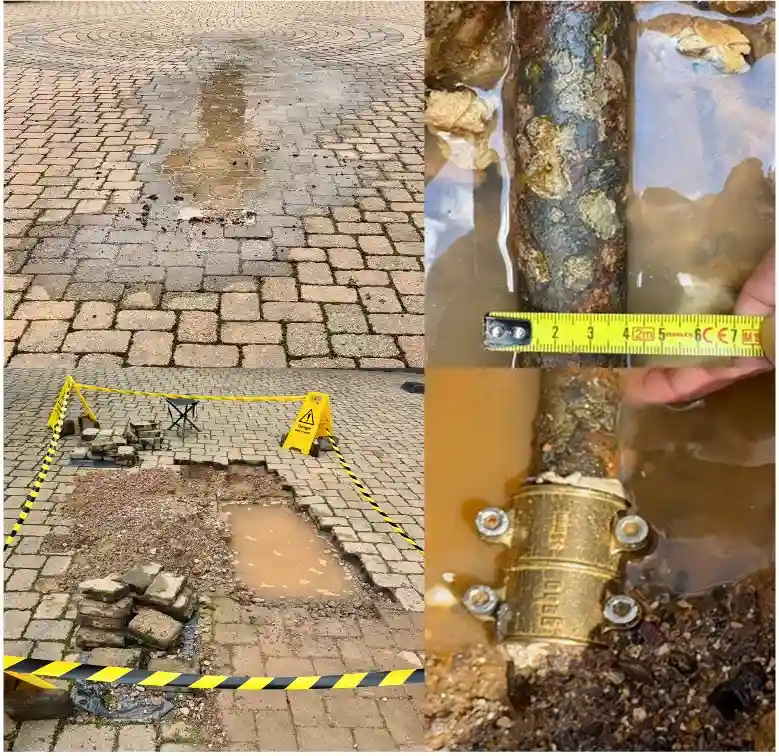
For a number of weeks, Ben had noticed a damp patch on his home’s drive spreading and starting to become a puddle
Following an investigation our plumbers dug a small trench to access to the leaking section of the cast iron pipe – connecting the mains to the house. The pipe had been in the ground for c90 years and although corroded was generally sound.
As part of the rectification, the pipe’s surface was made even and a permanent clamp fitted sealing the pin hole leak.
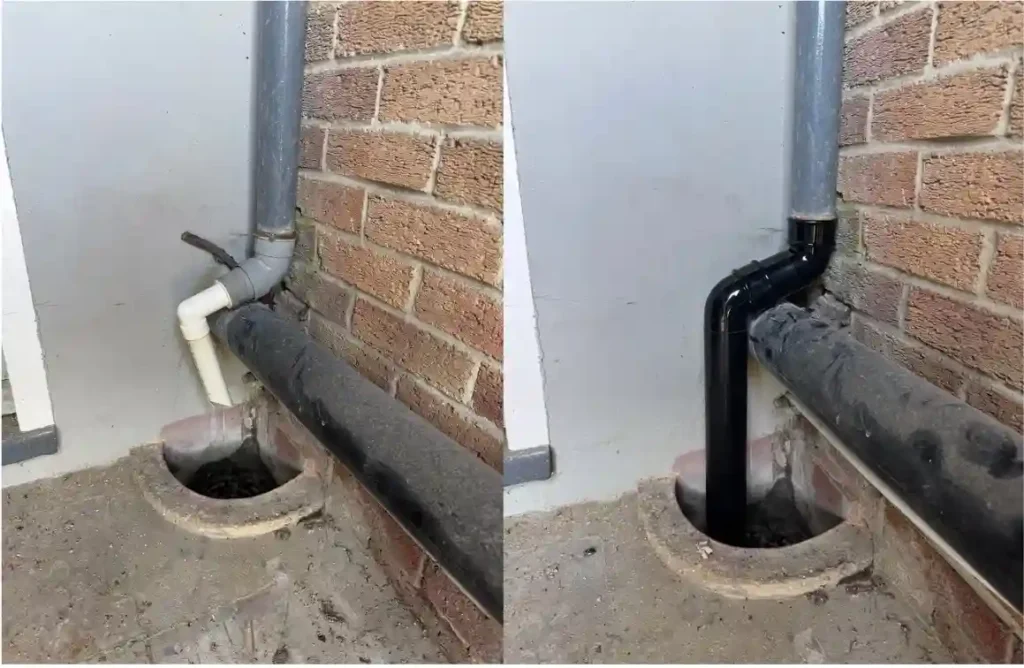
Dangerous drain pipe discharging (hot) water on to porch.
Faulty pipe replaced with new.
Customer – Henley home owner Estelle.
Following substantial building works, Estelle and her husband had recently moved into the house they’d purchased a year and a half ago.
Soon after, they noticed that the waste pipe leading from the upstairs bathroom to the outside drain was unsafe with hot and cold waste water flowing against an external wall as well as on the surrounding concrete floor.
Our plumber removed the hazardous pipe and fitted a new section appropriately terminating beneath the drain’s lip and above it’s grating – so that waste water flowed safely away and into the drain.
The quickest way to get in touch to discuss repairing or maintaining your home’s water and waste pipes is to WhatsApp, text or phone us on 07442966664.
Trustindex verifies that the company has a review score above 4.5, based on reviews collected on Google over the past 12 months, qualifying it to receive the Top Rated Certificate.
            Posted on Google        Christine An  14 days ago   Trustindex verifies that the original source of the review is Google. Unicorn plumber.  Always on time, responsive, professional and fixes all problems.  Had all the necessary parts with him to fix everything, even for a surprise problem.  Incredibly knowledgeable about all things plumbing (and general knowledge!).  Very happy to recommend him to everyone in my area of Henley/Hambleden.  He is also a Thames water approved plumber.        Posted on Google        laura boyes  14 days ago   Trustindex verifies that the original source of the review is Google. I have used Angus plumbing 3 times now and cannot recommend them enough. This time around I had a leak under my sink and couldn’t really work it out - turns out it was from some boxed in pipes. Plumber Paul diagnosed the issue super quick and no more leaking pipes :) super speedy, super friendly and super knowledgeable - Paul took time to explain a few things to me as well as showing how to turn the water supply off at my meter :) Do not hesitate to call for help with any plumbing issues or services 😍 thanks so much guys        Posted on Google        Laura Boyes  14 days ago   Trustindex verifies that the original source of the review is Google. I have used Angus plumbing twice now and couldn’t recommend them more. On both occasions they have attended at very short notice and sorted the issue quickly and efficiently. They also are great at giving advice and explaining the issues etc should they arise again. I wouldn’t hesitate to call them if needed again in the future. Thanks guys 10/10 :) Laura        Posted on Google        Jim Clarke  16 days ago   Trustindex verifies that the original source of the review is Google. Great service from Paul fitting a toilet at short notice in Caversham. Highly recommended        Posted on Google        David  17 days ago   Trustindex verifies that the original source of the review is Google. Paul was very friendly and professional. He did a great job of fixing our toilet, and we would definitely use Angus Plumbing again. Thank you!        Posted on Google        Chris Kelly  17 days ago   Trustindex verifies that the original source of the review is Google. A really prompt, friendly and great service. Thank you Paul! I'd recommend AngusPlumbing to everyone in Caversham.        Posted on Google        Joanna Wesołowska  20 days ago   Trustindex verifies that the original source of the review is Google. Excellent service from start to finish. The plumber was very friendly, polite and professional. He arrived on time, explained everything clearly and did a great job. Really happy with the service and would definitely recommend him to others!        Posted on Google        Nicholas Beveridge  28 days ago   Trustindex verifies that the original source of the review is Google. Paul was very friendly and professional, quickly responding to my message and helping me get the cheapest parts to repair my leaky toilet. He is the exact kind of plumber you want and is very honest and reasonable with his fees. I’ll definitely be using him again if anything goes wrong! Thanks again!        Posted on Google        Poppy Raven  28 days ago   Trustindex verifies that the original source of the review is Google. It was a bank holiday but Paul came promptly and fixed the problem quickly. A very nice chap and interesting to chat with.        Posted on Google        huseyin tapanci  44 days ago   Trustindex verifies that the original source of the review is Google. Angus Plumbing were excellent from start to finish. Professional, friendly and reliable, with great workmanship. Highly recommended!        Posted on Google        Janet Weekes  54 days ago   Trustindex verifies that the original source of the review is Google. Paul provided a great service. Very knowledgeable, honest and friendly.

He did a great job sorting out my water tank, was very reliable and to a good standard.

I would defintely use him again for any plumbing works.

Thank you so much Paul and for recommending other trades if needed.        Posted on Google        Moy Robson  57 days ago   Trustindex verifies that the original source of the review is Google. The inlet pipe to our toilet cistern developed a leak that we were unable to fix ourselves. We wanted to use a local plumber, and found Angus Plumbing online. They were able to offer us an appointment later the same day, and Paul arrived on time. He is such a lovely, friendly, positive person and we felt we had known him for years after only just meeting him. Better still, he did a very good, quick job to repair the leaking pipework and charged a very reasonable price (which included a new toilet flush system and valve). Highly recommended, and we will certainly be using Angus Plumbing again.        Posted on Google        Emma Connell  60 days ago   Trustindex verifies that the original source of the review is Google. A life changing visit! Paul managed to double our flow rates in one visit, now we can shower and wash the dishes at the same time in the house!
Friendly, knowledgeable, and very effective!
Thank you.        Posted on Google        Candace Au  67 days ago   Trustindex verifies that the original source of the review is Google. Paul is very professional and responsive, extremely grateful for having a trusted local plumber! ⭐️        Posted on Google        Will Smith  69 days ago   Trustindex verifies that the original source of the review is Google. Really good service from Paul and the team. They sorted my issue quickly and gave me a nice background of the business. Lovely guy, great team and would highly recommend!        Posted on Google        Leo Whyte  71 days ago   Trustindex verifies that the original source of the review is Google. I called Paul when we had an suspected water leak at our property. He was so helpful and friendly, saving me a lot of money in the process. I would highly recommend him and he becomes part of my local trusted circle.        Posted on Google        Alastair Beveridge  77 days ago   Trustindex verifies that the original source of the review is Google. Highly recommend! Had a low water pressure issue caused by our water softener, and Paul sorted it out quickly. Not only is he incredibly skilled, but he's also a genuinely nice, polite, and funny guy. While he was here, he took the time to teach me a few things and offered great solutions for some other minor plumbing issues we have. Outstanding service from start to finish—I’d recommend to anyone!        Posted on Google        Claire Alvey  77 days ago   Trustindex verifies that the original source of the review is Google. Great friendly local plumbing service for the Reading area. Angus Plumbing were able to see me at short notice to replace my burst pipe. Explained through the repairs that needed to be made and were able to make recommendations to help prevent future maintenance issues.        Posted on Google        Caroline Mayo  116 days ago   Trustindex verifies that the original source of the review is Google. Brilliant service, knowledgeable and friendly.
Would recommend and will be using again        Posted on Google        Mikaël Simard  117 days ago   Trustindex verifies that the original source of the review is Google. Paul came to our house to solve a plumbing issue - he was super friendly, quickly solved our issue and was overall a pleasure to interact with. Will definitely call AngusPLUMBING again whenever the next plumbing issue comes up :)           Verified by Trustindex  Trustindex verified badge is the Universal Symbol of Trust. Only the greatest companies can get the verified badge who has a review score above 4.5, based on customer reviews over the past 12 months. Read more
Your home - what type of pipes do you have?
Copper
There are over 400 different types of copper and copper alloy pipes in use in the UK.
How long your copper pipes function without leaking depends on water chemistry (acidic/hard water reduces life), installation quality (proper sizing, soldering, support), and environmental factors – soil acidity etc.
Since the 1960’s – in most UK homes, copper
Type-l (blue pipe markings), have been used to transport hot and cold water. With proper care and maintenance these will problem free for 50 plus years. And with proper installation and good water quality this may stretch to 80 or more.
Type-m copper pipe (identified by red markings on the pipe), is primarily used for low-pressure interior residential uses such as branch water supply lines and heating systems. These are thinner and less durable than type-l and should last for between 20 to 50 years.
The third pipe you may find used is type-k (green markings). These have thicker walls than type-m which protects them from mechanical damage and corrosion making, so ideal for buried lines. These can be expected to last over 100 years.
Steel, lead and iron
In older houses, plumbing’s often made a range of metals. The most common are cast iron, galvanised steel and of course lead.
Galvanized steel’s common in houses built before the 1960s, and their zinc coating protects against rust. But eventually they corrode from the inside, leading to low water pressure, rusty water, and potential leaks or ruptures.
Cast iron pipes are often found in pre-1970s/80s homes. The metal’s durable but prone to rust and deterioration corroding internally over time. The result – potential backups/blockages, leaks, foul odours, and discoloured water.
Both steel and iron pipes require regular inspection and are now days often replaced with modern materials such as plastic/PVC providing longer term reliability.
Lead. Properties built before 1970 will often have lead pipes, including the underground pipe connecting to the mains. With lead’s flexibility, these were much easier to install than galvanised steel and cast iron pipes. But came with what were found to be significant health risks through leaching into drinking water. This is especially for young children and pregnant women, affecting brain development and causing other general health issues including cardiovascular problems, kidney damage and high blood pressure.
Lead pipes were banned in the UK for new water installations in 1969, with the regulations fully in force by 1970.
Plastic
Plastic and PVC pipes have become the standard way to transport water around your home over the last 20 years. They are quicker and easier to install than metal pipes and also deal with issues like rust, corrosion, low water pressure, and potential health risks from lead leaching into the water.
While older PVC can be expected to last 40-50 years, with modern formulations, proper installation and ideal conditions they’ll be problem free for 100 plus years.
Why's this important?
Knowing the pipe’s your home has is extremely helpful. It will enable you to decide the best way to keep them working as they should, so that your family’s kept safe and healthy.
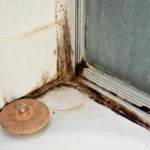
Maintaining water and waste pipes is also crucial for preventing costly property damage (such as damp, mould, flooding), avoiding foul odours, protecting structural integrity, and safeguarding the environment from sewage contamination.
Ignoring them leads to blockages, leaks, and bursts, creating expensive, disruptive, and hazardous issues for you and your neighbours.
7 reasons for maintenance
Property protection: Prevents water pooling, dampness, mould, and potential foundation damage, preserving your home’s structure.
Health & hygiene: Stops bacteria, pathogens, and pests (like mosquitoes) from breeding in stagnant water, reducing illness risks.
Cost savings: Proactive maintenance catches small issues before they become major, expensive repairs or replacements.
Protect insurance claims: Many UK insurance policies require proof of regular maintenance; without it, claims for water damage are often rejected.
Environmental safety: Prevents sewage leaks from contaminating soil and watercourses, protecting wildlife and ecosystems.
Functionality: Ensures smooth water flow, preventing slow drains, backups, and inefficient water usage.
Blockages & overflows: Food, hair, wipes, and grease build-up cause serious clogs, leading to overflows inside or outside.
Corrosion & leaks: Weakened pipes can crack, leading to leaks, water wastage, and structural damage.
Pest infestations: Stagnant water and waste attract rodents, insects, and other pests.
3 simple DIY maintenance tips
Don’t put grease, food scraps, wipes, or sanitary products down drains.
Regularly clean out gully traps and check gutters for blockages.
Ensure connections are secure and pipes are properly aligned.
Pipe repair
And if you do need to repair your pipes or want a plumber to do this, knowing the type(s) of pipes your home has will make this a quicker and cheaper thing to do.
Other plumbing services....
Our local plumbers provide a range of expert plumbing services that’ll keep you and your family safe, save you money and your home running smoothly and as it should including:
Improving water pressure and flow (to see our work click here).