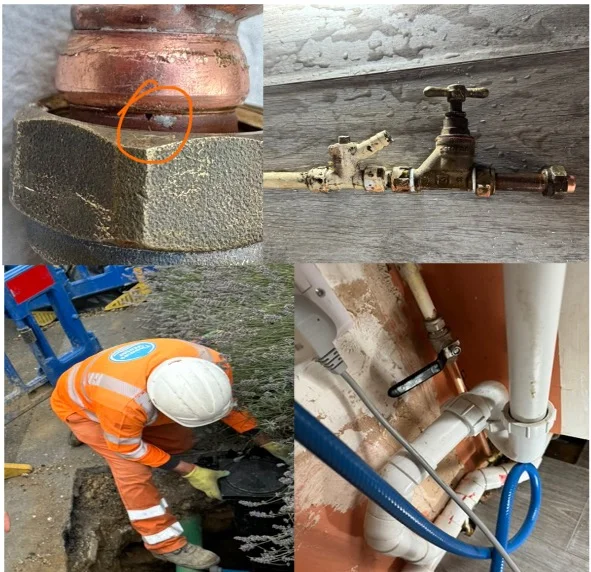
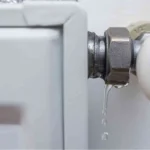
Neil (and his young family) noticed a leak on their incoming water mains pipework just above their internal stopcock in their kitchen.
They got in touch and our plumbers were with them within 30 minutes. Unfortunately the internal stopcock had seized and the street Thames Water stop tap had failed – which meant that the water could not be turned off preventing the leak from being fixed.
Thames Water were called out on an emergency to replace their stop tap which they did within three hours. This enabled our plumber to replace the home’s internal stop tap and repair the leak.
Pinhole leak on incoming mains.
New stopcock/Thames Water call out.
Goring customer – Home owner Claire.
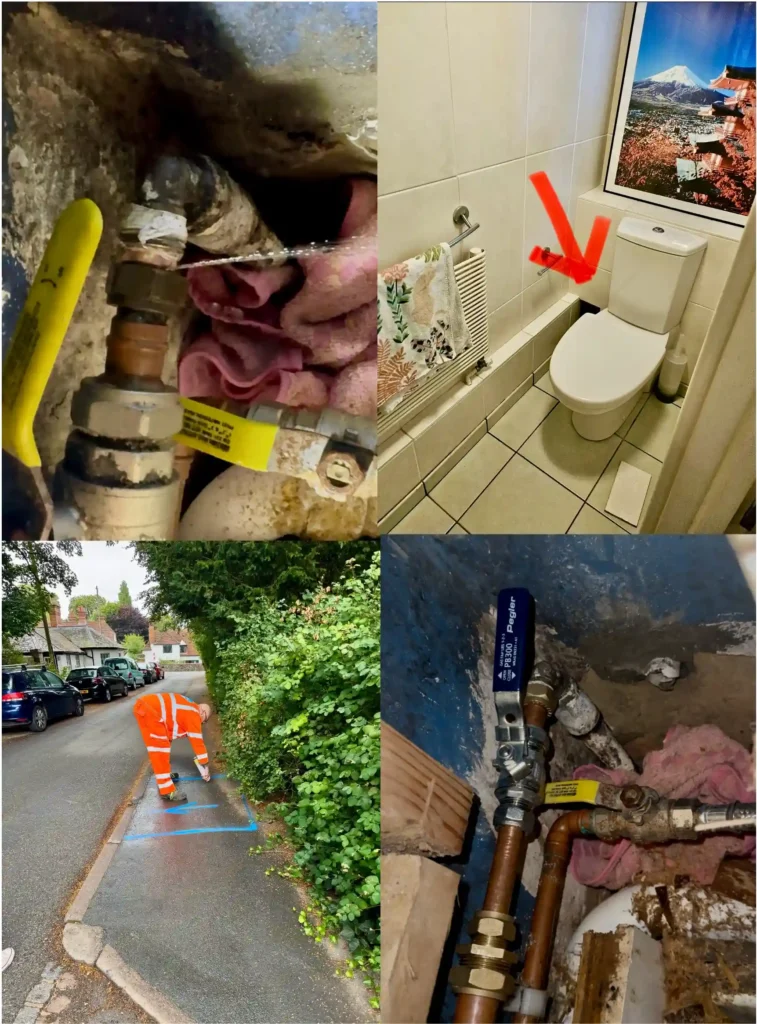
Claire noticed a hissing sound coming from behind her home’s downstairs toilet where the mains water entered the property.
Opening up the boxing showed a pinhole leak on the incoming water mains, before the internal stopcock and inaccessible.
Thames Water were contacted and after looking through their records identified an old, defunct stop cock connected to the house that could be reinstated.
Works took place the same day enabling the mains water to be shut off and the pin-holed pipe to be replaced.
The quickest way to get in touch to discuss turning off your water supply is to WhatsApp, text or phone us on 07442966664.
Trustindex verifies that the company has a review score above 4.5, based on reviews collected on Google over the past 12 months, qualifying it to receive the Top Rated Certificate.
            Posted on Google        Christine An  14 days ago   Trustindex verifies that the original source of the review is Google. Unicorn plumber.  Always on time, responsive, professional and fixes all problems.  Had all the necessary parts with him to fix everything, even for a surprise problem.  Incredibly knowledgeable about all things plumbing (and general knowledge!).  Very happy to recommend him to everyone in my area of Henley/Hambleden.  He is also a Thames water approved plumber.        Posted on Google        laura boyes  14 days ago   Trustindex verifies that the original source of the review is Google. I have used Angus plumbing 3 times now and cannot recommend them enough. This time around I had a leak under my sink and couldn’t really work it out - turns out it was from some boxed in pipes. Plumber Paul diagnosed the issue super quick and no more leaking pipes :) super speedy, super friendly and super knowledgeable - Paul took time to explain a few things to me as well as showing how to turn the water supply off at my meter :) Do not hesitate to call for help with any plumbing issues or services 😍 thanks so much guys        Posted on Google        Laura Boyes  14 days ago   Trustindex verifies that the original source of the review is Google. I have used Angus plumbing twice now and couldn’t recommend them more. On both occasions they have attended at very short notice and sorted the issue quickly and efficiently. They also are great at giving advice and explaining the issues etc should they arise again. I wouldn’t hesitate to call them if needed again in the future. Thanks guys 10/10 :) Laura        Posted on Google        Jim Clarke  16 days ago   Trustindex verifies that the original source of the review is Google. Great service from Paul fitting a toilet at short notice in Caversham. Highly recommended        Posted on Google        David  17 days ago   Trustindex verifies that the original source of the review is Google. Paul was very friendly and professional. He did a great job of fixing our toilet, and we would definitely use Angus Plumbing again. Thank you!        Posted on Google        Chris Kelly  17 days ago   Trustindex verifies that the original source of the review is Google. A really prompt, friendly and great service. Thank you Paul! I'd recommend AngusPlumbing to everyone in Caversham.        Posted on Google        Joanna Wesołowska  20 days ago   Trustindex verifies that the original source of the review is Google. Excellent service from start to finish. The plumber was very friendly, polite and professional. He arrived on time, explained everything clearly and did a great job. Really happy with the service and would definitely recommend him to others!        Posted on Google        Nicholas Beveridge  28 days ago   Trustindex verifies that the original source of the review is Google. Paul was very friendly and professional, quickly responding to my message and helping me get the cheapest parts to repair my leaky toilet. He is the exact kind of plumber you want and is very honest and reasonable with his fees. I’ll definitely be using him again if anything goes wrong! Thanks again!        Posted on Google        Poppy Raven  28 days ago   Trustindex verifies that the original source of the review is Google. It was a bank holiday but Paul came promptly and fixed the problem quickly. A very nice chap and interesting to chat with.        Posted on Google        huseyin tapanci  44 days ago   Trustindex verifies that the original source of the review is Google. Angus Plumbing were excellent from start to finish. Professional, friendly and reliable, with great workmanship. Highly recommended!        Posted on Google        Janet Weekes  54 days ago   Trustindex verifies that the original source of the review is Google. Paul provided a great service. Very knowledgeable, honest and friendly.

He did a great job sorting out my water tank, was very reliable and to a good standard.

I would defintely use him again for any plumbing works.

Thank you so much Paul and for recommending other trades if needed.        Posted on Google        Moy Robson  57 days ago   Trustindex verifies that the original source of the review is Google. The inlet pipe to our toilet cistern developed a leak that we were unable to fix ourselves. We wanted to use a local plumber, and found Angus Plumbing online. They were able to offer us an appointment later the same day, and Paul arrived on time. He is such a lovely, friendly, positive person and we felt we had known him for years after only just meeting him. Better still, he did a very good, quick job to repair the leaking pipework and charged a very reasonable price (which included a new toilet flush system and valve). Highly recommended, and we will certainly be using Angus Plumbing again.        Posted on Google        Emma Connell  60 days ago   Trustindex verifies that the original source of the review is Google. A life changing visit! Paul managed to double our flow rates in one visit, now we can shower and wash the dishes at the same time in the house!
Friendly, knowledgeable, and very effective!
Thank you.        Posted on Google        Candace Au  67 days ago   Trustindex verifies that the original source of the review is Google. Paul is very professional and responsive, extremely grateful for having a trusted local plumber! ⭐️        Posted on Google        Will Smith  69 days ago   Trustindex verifies that the original source of the review is Google. Really good service from Paul and the team. They sorted my issue quickly and gave me a nice background of the business. Lovely guy, great team and would highly recommend!        Posted on Google        Leo Whyte  71 days ago   Trustindex verifies that the original source of the review is Google. I called Paul when we had an suspected water leak at our property. He was so helpful and friendly, saving me a lot of money in the process. I would highly recommend him and he becomes part of my local trusted circle.        Posted on Google        Alastair Beveridge  77 days ago   Trustindex verifies that the original source of the review is Google. Highly recommend! Had a low water pressure issue caused by our water softener, and Paul sorted it out quickly. Not only is he incredibly skilled, but he's also a genuinely nice, polite, and funny guy. While he was here, he took the time to teach me a few things and offered great solutions for some other minor plumbing issues we have. Outstanding service from start to finish—I’d recommend to anyone!        Posted on Google        Claire Alvey  77 days ago   Trustindex verifies that the original source of the review is Google. Great friendly local plumbing service for the Reading area. Angus Plumbing were able to see me at short notice to replace my burst pipe. Explained through the repairs that needed to be made and were able to make recommendations to help prevent future maintenance issues.        Posted on Google        Caroline Mayo  116 days ago   Trustindex verifies that the original source of the review is Google. Brilliant service, knowledgeable and friendly.
Would recommend and will be using again        Posted on Google        Mikaël Simard  117 days ago   Trustindex verifies that the original source of the review is Google. Paul came to our house to solve a plumbing issue - he was super friendly, quickly solved our issue and was overall a pleasure to interact with. Will definitely call AngusPLUMBING again whenever the next plumbing issue comes up :)           Verified by Trustindex  Trustindex verified badge is the Universal Symbol of Trust. Only the greatest companies can get the verified badge who has a review score above 4.5, based on customer reviews over the past 12 months. Read more
Turning off your water supply?
Turn the water off. How do you turn off your homes water? When and why would you need to do this?
Being able to turn off the mains water’s needed for planned maintenance and essential in when you’ve a sudden emergency.
Emergency situations
The most urgent reason to shut off the mains is to stop active flooding.
Burst pipes: Often caused by freezing temperatures in winter or high water pressure, a burst pipe can unleash hundreds of gallons of water per hour.
Major leaks: If a pipe behind a wall or under a floor begins to leak heavily, shutting the mains is the only way to prevent structural damage, mould growth, and electrical hazards.
Uncontrollable overflows: If a toilet or sink is overflowing and the local isolation valve is stuck or missing, the main stopcock must be used to stop the flow.
Natural disasters: During events like severe storms, shutting off the water can prevent internal flooding if external drains are blocked or damaged.
Planned maintenance and repairs
You must shut off the water supply to work safely on any part of the plumbing system that does not have its own isolation valve. This includes installing new taps, showers, or water heaters.
Appliance installation: Connecting a new dishwasher or washing machine often requires a temporary shut-off to prevent leaks during the hookup.
Upgrading your home’s water system: If you are renovating a bathroom or replacing old, corroded pipework, the mains must be isolated.
Extended absence (holidays etc.)
Turning off the water when you leave for more than 24 hours is a highly recommended safety precaution. If you do not do this and there is a subsequent burst pipe or problem with your home’s plumbing that causes water damage your insurer may not pay out as you have not mitigated their risk/exposure. Its good practice to check your policy each time it renews so that you are aware of your insurance company’s requirements.
Preventing “silent” disasters: A small leak that starts while you are away can go unnoticed for weeks, leading to catastrophic damage and high utility bills.
Winter protection: If you are away during cold months, shutting the water and draining the pipes prevents them from freezing and bursting in your absence.
Testing the valve: It is recommended to turn your main stopcock off and back on at least once a year to ensure it hasn’t seized up from mineral buildup, so it works if you need it in a real emergency.
How do you turn off the water?
To turn off the mains water to your house, you primarily use the inside stopcock (or stop valve). If this is inaccessible or faulty, you can use the external stop tap.
Using the inside stopcock (preferred)
This is the main valve inside your property that controls the flow of water into your internal plumbing system. Common locations include:
Under the kitchen sink (the most common spot).
In a utility room, garage, or cellar.
Under the stairs or in a hallway cupboard.
Behind a panel in a downstairs bathroom or near the boiler.
Turn off the stopcock
Turn the stopcock’s handle clockwise (righty-tighty) until you feel resistance. Do not force it if it is seized; use gentle pressure. You can apply a small amount of penetrating oil (like WD-40 penetrant not regular WD-40) if it is stiff. It may take a few minutes for the water already in the pipes to drain out after the valve is closed.
Using the external stop tap (secondary)
If you can’t find or operate the internal valve, you must use the external one, which is usually located near the boundary of your property.
Location: Look for a small metal or plastic cover on the pavement or driveway, often marked with a “W” or “Water”.
Turn off the stop tap
Lift the lid (you may need a screwdriver to pry it open).
The valve is often deep underground; you may need a stop tap key (available at most DIY stores) to reach it.
If it’s not deep underground, you may find a long blue or black plastic “key” connected to the water meter. If this is missing a size 10 hex/allen key can normally be used as an alternative.
Turn it clockwise until the water stops.
Warning. In many areas, the external stop tap belongs to the water utility company. It should only be used in an emergency, and be aware that in terraced houses or flats, it may turn off the supply for your neighbours as well.
Isolating specific fixtures
If you only need to stop water to a single tap, toilet, or appliance, look for isolation valves on the pipes directly connected to them.
Chrome/slotted valves: Use a flat-head screwdriver to turn the slot 90 degrees so it is perpendicular (across) the pipe.
Lever valves: Turn the blue or red handle 90 degrees so it is no longer parallel with the pipe.
Confirmation. After turning any valve off, open a cold-water tap on the lowest floor to verify that the flow eventually stops and to relieve remaining pressure in the system.
Other plumbing services....
Our local plumbers provide a range of expert plumbing services that’ll keep you and your family safe, save you money and your home running smoothly and as it should including:
Improving water pressure and flow (to see our work click here).