Taps & valves - install & repair
...........................................
Your trusted, local same-day plumbers
Some of our recent work....
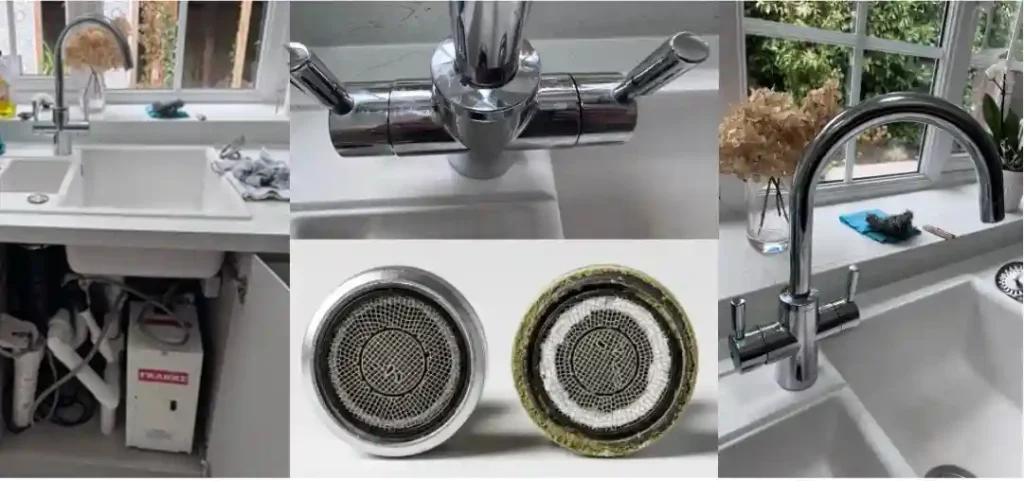
Franke boiling water tap – wobbly handle, no water.
Caversham customer – Home owner Patricia.
Four years ago, Patricia and her husband had a large exension built – which would become their kitchen. With this they had a Franke boiling water tap fitted providing instant hot water.
Over time and with only normal use, the boiling water tap stem became dangerously lose and would not return to its original “off” position after use, which we corrected for them.
Just over a week later, the tap’s water flow stopped with the exception of a very small drip when the tap was in a closed position.
When this occurs, usually, the tap cartridge has become faulty and needs to be replaced. However, as the tap was only three years old, this although possible wasn’t likely.
The Franke tap system includes a basic filtration cartridge requiring replacement every 3-6 months. When we confirmed that neither an additional water conditioner or water softener was installed in the house, it was likely that the blockage was in the tap’s spout filter.
After a quick check, this was confirmed and the spout filter cleaned returning the tap to a working condition. And saving the customer an hour of plumber time as well as the cost of a new cartridge.
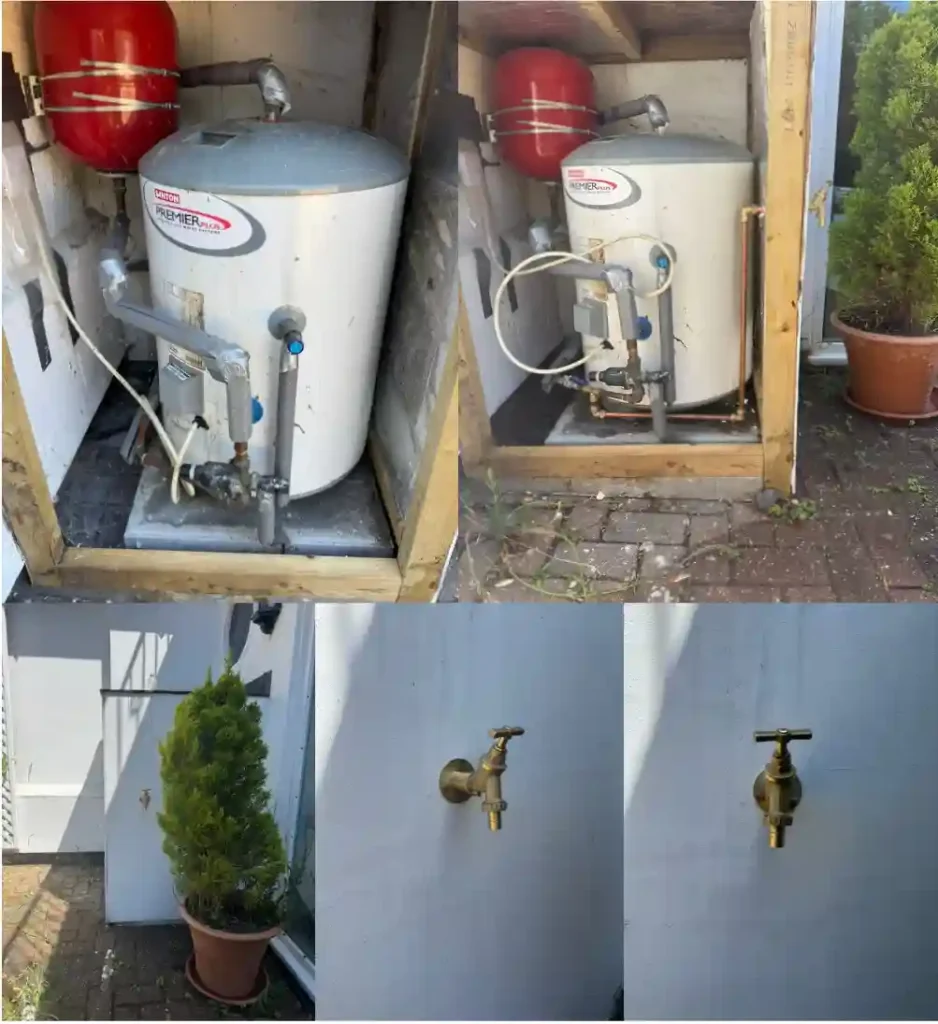
New outside/garden tap.
Caversham customer – Homeowner Claire.
Since buying their Caversham home, Claire and her husband had been watering the back garden using their only outside tap – which was at the front of the house. This required taking the hose through the garage and returning to the front to turn the water on. And when finished, taking the hose back to the front of the house so that the front garden could be watered and hose stored.
At the back of the house was an unvented cylinder that served one of the property’s anexes. And it was planned to tap into the cold water supply here and fit a new garden tap. On isolating the house’s water supply via internal stop tap, it was found that the cylinder’s supply was not on this water line.
As the house did not have a pavement / roadside thames water stopcock, isolating the supply would have required Thames Water to turn off supply to a number of connected roads.
After a discussion with Claire it was decided that the cold water line would be cut into live and a new stop tap installed. This took place with minimal disruption with the new stop tap as well as the new garden tap up and running in less than an hour.
The quickest way to get in touch to discuss repairing or installing taps and valves is to WhatsApp, text or phone us on 07442966664.
You can also email plumbing@angusplumbing.co.uk or use the form – and well get back to you as soon as we can.
The AngusPLUMBING team
 5.0verified by TrustindexTrustindex verifies that the company has a review score above 4.5, based on reviews collected on Google over the past 12 months, qualifying it to receive the Top Rated Certificate.
Posted on Google
 Christine An14 days ago
Trustindex verifies that the original source of the review is Google.
Unicorn plumber. Always on time, responsive, professional and fixes all problems. Had all the necessary parts with him to fix everything, even for a surprise problem. Incredibly knowledgeable about all things plumbing (and general knowledge!). Very happy to recommend him to everyone in my area of Henley/Hambleden. He is also a Thames water approved plumber.Posted on Google laura boyes14 days agoI have used Angus plumbing 3 times now and cannot recommend them enough. This time around I had a leak under my sink and couldn’t really work it out - turns out it was from some boxed in pipes. Plumber Paul diagnosed the issue super quick and no more leaking pipes :) super speedy, super friendly and super knowledgeable - Paul took time to explain a few things to me as well as showing how to turn the water supply off at my meter :) Do not hesitate to call for help with any plumbing issues or services 😍 thanks so much guysPosted on Google
 Laura Boyes14 days agoI have used Angus plumbing twice now and couldn’t recommend them more. On both occasions they have attended at very short notice and sorted the issue quickly and efficiently. They also are great at giving advice and explaining the issues etc should they arise again. I wouldn’t hesitate to call them if needed again in the future. Thanks guys 10/10 :) LauraPosted on Google
 Jim Clarke16 days agoGreat service from Paul fitting a toilet at short notice in Caversham. Highly recommendedPosted on Google
 David17 days agoPaul was very friendly and professional. He did a great job of fixing our toilet, and we would definitely use Angus Plumbing again. Thank you!Posted on Google
 Chris Kelly17 days agoA really prompt, friendly and great service. Thank you Paul! I'd recommend AngusPlumbing to everyone in Caversham.Posted on Google
 Joanna Wesołowska20 days agoExcellent service from start to finish. The plumber was very friendly, polite and professional. He arrived on time, explained everything clearly and did a great job. Really happy with the service and would definitely recommend him to others!Posted on Google
 Nicholas Beveridge28 days agoPaul was very friendly and professional, quickly responding to my message and helping me get the cheapest parts to repair my leaky toilet. He is the exact kind of plumber you want and is very honest and reasonable with his fees. I’ll definitely be using him again if anything goes wrong! Thanks again!Posted on Google
 Poppy Raven28 days agoIt was a bank holiday but Paul came promptly and fixed the problem quickly. A very nice chap and interesting to chat with.Posted on Google
 huseyin tapanci44 days agoAngus Plumbing were excellent from start to finish. Professional, friendly and reliable, with great workmanship. Highly recommended!Posted on Google
 Janet Weekes54 days agoPaul provided a great service. Very knowledgeable, honest and friendly. He did a great job sorting out my water tank, was very reliable and to a good standard. I would defintely use him again for any plumbing works. Thank you so much Paul and for recommending other trades if needed.Posted on Google
 Moy Robson57 days agoThe inlet pipe to our toilet cistern developed a leak that we were unable to fix ourselves. We wanted to use a local plumber, and found Angus Plumbing online. They were able to offer us an appointment later the same day, and Paul arrived on time. He is such a lovely, friendly, positive person and we felt we had known him for years after only just meeting him. Better still, he did a very good, quick job to repair the leaking pipework and charged a very reasonable price (which included a new toilet flush system and valve). Highly recommended, and we will certainly be using Angus Plumbing again.Posted on Google
 Emma Connell60 days agoA life changing visit! Paul managed to double our flow rates in one visit, now we can shower and wash the dishes at the same time in the house! Friendly, knowledgeable, and very effective! Thank you.Posted on Google
 Candace Au67 days agoPaul is very professional and responsive, extremely grateful for having a trusted local plumber! ⭐️Posted on Google
 Will Smith69 days agoReally good service from Paul and the team. They sorted my issue quickly and gave me a nice background of the business. Lovely guy, great team and would highly recommend!Posted on Google
 Leo Whyte71 days agoI called Paul when we had an suspected water leak at our property. He was so helpful and friendly, saving me a lot of money in the process. I would highly recommend him and he becomes part of my local trusted circle.Posted on Google
 Alastair Beveridge77 days agoHighly recommend! Had a low water pressure issue caused by our water softener, and Paul sorted it out quickly. Not only is he incredibly skilled, but he's also a genuinely nice, polite, and funny guy. While he was here, he took the time to teach me a few things and offered great solutions for some other minor plumbing issues we have. Outstanding service from start to finish—I’d recommend to anyone!Posted on Google
 Claire Alvey77 days agoGreat friendly local plumbing service for the Reading area. Angus Plumbing were able to see me at short notice to replace my burst pipe. Explained through the repairs that needed to be made and were able to make recommendations to help prevent future maintenance issues.Posted on Google
 Caroline Mayo116 days agoBrilliant service, knowledgeable and friendly. Would recommend and will be using againPosted on Google
 Mikaël Simard117 days agoPaul came to our house to solve a plumbing issue - he was super friendly, quickly solved our issue and was overall a pleasure to interact with. Will definitely call AngusPLUMBING again whenever the next plumbing issue comes up :)Verified by TrustindexTrustindex verified badge is the Universal Symbol of Trust. Only the greatest companies can get the verified badge who has a review score above 4.5, based on customer reviews over the past 12 months. Read more
Taps - some background
With taps and water management becoming mainstream and spreading with the Romans, technology-wise they remained largely unchanged until the 19th century which saw the development of the:
- Screw-down tap: credited to Thomas Grill in 1800, this invention allowed for precise adjustment of water flow rather than just a simple on/off state. The first widely manufactured screw-down mechanism was patented in 1845 by the Rotherham brass founders Guest and Chrimes.
- Mixer tap (1880): Canadian inventor Thomas Campbell patented the first tap with a single outlet that could mix hot and cold water streams.
And with it, the 20th century saw the development of the:
- Single-handle mixer (1937): American student Alfred Moen invented the single-handle mixing tap after scalding his hands with an old-fashioned two-handle model. His design became mass-produced after World War II, starting in 1947.
- Ceramic disc technology, which replaced traditional rubber washers to prevent leaks, began spreading in the late 1970s. The first hands-free, sensor-activated tap was patented in 1981 by Norman Wareham.
What’s clear is that for homes water taps are essential fixtures and bridge the gap between water supply companies and consumers – providing a controlled and immediate way to access fresh water. Their importance to falls into five main areas:
- Health and hydration: Taps provide a reliable source of high-quality drinking water, which is a healthy alternative to sugary drinks and helps prevent conditions like obesity, diabetes, and tooth decay. In the UK alone, utility companies supply clean tap water to over 60 million people daily.
- Hygiene and sanitation: Taps are fundamental for daily tasks such as handwashing, bathing, and cleaning, which are critical for preventing the spread of infectious diseases. Access to running water for handwashing significantly reduces the transmission of germs in homes, offices, and healthcare facilities.
- Public health legacy: Historically, the development of taps and indoor plumbing was central to eliminating waterborne diseases like cholera and typhoid. Today, routine cleaning of taps remains a key World Health Organization (WHO) recommendation for maintaining safe water points.
- Environmental sustainability: Choosing tap water over bottled water reduces plastic waste and lowers carbon emissions associated with the production and transport of bottled beverages. Tap water is effectively transported with minimal environmental impact compared to the 2-3 liters of water required to produce every one liter of bottled water.
- Economic efficiency: Tap water is highly affordable, often costing less than 0.1p per litre, making it considerably cheaper than bottled alternatives.Modern innovations such as sensor taps and aerators can reduce water consumption by 30–70%, helping businesses and households meet sustainability goals and lower utility bills.
If you’re a skilled and experienced DIY-er, some common problems with taps can be easily addressed without a using a plumber:
- Dripping spout: Usually caused by a worn-out rubber washer in older compression taps or a damaged ceramic disc in modern mixer taps.
- Leaking handle: Often indicates a faulty O-ring or gland nut that needs tightening or replacing.
- Reduced flow: Frequently caused by mineral buildup or debris in the aerator; unscrew and soak it in white vinegar (5% or ideally 20%) to clear.
- Stiff handle: Can be temporarily resolved with plumber’s silicone lubricant, though permanent damage often requires a new cartridge.
Important safety tip. Before attempting any DIY repair, always turn off the water supply at the isolation valve or main stopcock and drain the remaining water from the pipes.
When to get a plumber in
While many minor leaks can be fixed with a basic DIY kit, certain complex issues in require a qualified plumber to prevent structural water damage or the invalidation of home insurance.
High-tech and specialist tap systems
- Boiling water taps (e.g. Quooker, Billi): These systems involve pressurised tanks, heating elements, and sophisticated electronics. Attempting a DIY repair may lead to severe steam burns or electrical hazards. Most manufacturers require certified technicians to maintain the parts and labour warranty.
- Touchless/sensor taps: Repairing these involves troubleshooting infrared sensors and solenoid valves. Professional diagnostic tools are usually needed to fix electrical faults without damaging the circuitry.
Issues involving concealed plumbing
- Wall-mounted taps: In many modern homes taps are often built directly into the wall. Accessing the valves often requires removing tiles or panels. A professional ensures that the internal connections are watertight before the wall is resealed, preventing “hidden” leaks that cause rot.If the water is pooling away from the tap itself, it may indicate a burst pipe or a faulty connection behind the cabinetry. Professionals use leak detection equipment to find the source without unnecessary demolition.
High-pressure and mains supply problems
- No isolation valve: If your tap lacks local shut-off valves, the entire property’s water must be turned off at the main stopcock. If the stopcock is seized or the pipes are old (lead or cast iron etc.), a professional is needed to manage the risk of pipe failure during the repair.
- Water hammer or vibrating pipes: Loud banging noises when the tap is turned off indicate a pressure surge. This requires a plumber to install a “water hammer arrestor” or adjust the pressure-reducing valve to prevent the pipes from eventually bursting.
- Seized or severely corroded parts: If a tap’s heavily calcified and won’t budge with standard tools, applying too much force can snap the supply pipe or crack a ceramic sink. A plumber has the specialised tools (like a basin wrench or heat induction) to remove seized parts safely.
Tap installation
Many DIY competent homeowners are more than capable of replacing a basic tap. For complex installations, legal compliance, and preventing long-term water damage, hiring a professional plumber’s recommended with benefits including:
- Compliance and insurance: Licensed plumbers ensure work meets local building codes and Water Fittings Regulations. This is vital for maintaining homeowner’s insurance and can prevent potential fines.
- Long-term guarantees: Most professional plumbers provide warranties on both labour and parts, offering protection if leaks occur later.
- Efficiency: A professional can typically fit a standard tap in 30 to 60 minutes, whereas a DIY attempt may take several hours or require multiple trips for specialised tools like a basin spanner.
- Safety: Professionals are trained to identify underlying issues, such as water hammer or hidden leaks behind walls, which could lead to structural rot or mould if left unaddressed.
When a plumber’s needed
- Lack of isolation valves: If there are no shut-off valves under the sink, the mains supply must be turned off. A plumber is needed to safely manage older pipework that may be prone to failure during this process.
- Modifying pipework: You should use a plumber if the new tap requires changing the existing plumbing configuration, such as converting separate hot and cold taps into a single mixer tap or moving connections.
- Corroded or stuck fittings: In older properties, taps often have seized or corroded threads. Attempting to force these can damage the supply pipes or the sink itself.
- Specialist tap systems: Installation of boiling water taps (e.g., Quooker), water filter taps, or smart taps requires professional expertise to handle integrated heating elements and electronics.
- New outdoor taps: Installing an exterior tap must comply with UK Water Regulations, which require a double check valve to prevent backflow and contamination of the main water supply.
Tap repair
If you’re a skilled and experienced DIY-er, some common problems with taps can be easily addressed without a using a plumber:
- Dripping spout: Usually caused by a worn-out rubber washer in older compression taps or a damaged ceramic disc in modern mixer taps.
- Leaking handle: Often indicates a faulty o-ring or gland nut that needs tightening or replacing.
- Reduced flow: Frequently caused by mineral buildup or debris in the aerator; unscrew and soak it in white vinegar to clear.
- Stiff handle: Can be temporarily resolved with plumber’s silicone lubricant, though permanent damage often requires a new cartridge.
|
Important safety tip. Before attempting any DIY repair, always turn off the water supply at the isolation valve or main stopcock and drain the remaining water from the pipes.
When to get a plumber in
While many minor leaks can be fixed with a basic DIY kit, certain complex issues in require a qualified plumber to prevent structural water damage or the invalidation of home insurance.
High-tech and specialist tap systems
- Boiling water taps (e.g., Quooker, Billi): These systems involve pressurised tanks, heating elements, and sophisticated electronics. Attempting a DIY repair can lead to severe steam burns or electrical hazards. Most manufacturers require certified technicians to maintain the parts and labour warranty.Repairing these involves troubleshooting infrared sensors and solenoid valves. Professional diagnostic tools are usually needed to fix electrical faults without damaging the circuitry.
Issues involving concealed plumbing
- Wall-mounted taps: In many modern homes taps are often built directly into the wall. Accessing the valves often requires removing tiles or panels. A professional ensures that the internal connections are watertight before the wall is resealed, preventing “hidden” leaks that cause rot.
- Leaks under the sink or floor: If the water is pooling away from the tap itself, it may indicate a burst pipe or a faulty connection behind the cabinetry. Professionals use leak detection equipment to find the source without unnecessary demolition.
High-pressure and mains supply problems
- No isolation valve: If your tap lacks local shut-off valves, the entire property’s water must be turned off at the main stopcock. If the stopcock is seized or the pipes are old (lead or copper), a professional is needed to manage the risk of pipe failure during the repair.
- Water hammer or vibrating pipes: Loud banging noises when the tap is turned off indicate a pressure surge. This requires a plumber to install a “water hammer arrestor” or adjust the pressure-reducing valve to prevent the pipes from eventually bursting.
- Seized or severely corroded parts: If a tap is heavily calcified and won’t budge with standard tools, applying too much force can snap the supply pipe or crack a ceramic sink. A plumber has the specialised tools (like a basin wrench or heat induction) to remove seized parts safely.
Other plumbing services....
Our local plumbers provide a range of expert plumbing services that’ll keep you and your family safe, save you money and your home running smoothly and as it should including:
- Improving water pressure and flow (to see our work click here).
- Leak detection (to see our work click here).
- Water and waste pipe repair & maintenance (to see our work click here).
- Unblocking waste systems (to see our work click here).
- Dripping/running overflow pipe investigation (to see our work click here).
- Turning off/isolating your homes water supply (to see our work click here).
- Softening/conditioning your home’s water (to see our work click here).
- Repairing and maintaining your home’s water tanks (to see our work click here).
- Installing, repairing and de-commissioning your home’s kitchen, bathroom and WC electrics (to see our work click here).
Kitchen plumbing
& appliances
With our kitchen plumbing services, we provide expert installation and repairs.
Bathroom
plumbing
Our bathroom plumbing services ensure everything runs smoothly.
Toilets &
sanitary
We also specialise in toilet plumbing services to resolve any issues.
Taps &
valves
We provide tap and valve plumbing services for optimal water flow.
Heating & hot / cold water
Heating plumbing services are crucial for maintaining comfortable living spaces.
Outdoor & garden plumbing
Outdoor & garden plumbing services ensure your garden thrives and home’s sound.
Our Mastering - no frills series....
…. gives confident, capable homeowners and DIYers the knowledge and skills needed to troubleshoot and repair common plumbing problems.
An essential read if you're a home owner, renter or landlord!

& our Plumbing blog....
…. provides free expert plumbing heating and renewables tips and advice.